
-
9036 Reseda Blvd #105 Northridge, Ca 91324
-
Email Address quotes@movieinsure.com
-
Phone No 1.888.959.0772
Stunt Library · Falls
Stunt Falls & High Falls
From a stumble onto a mat to a two-story drop into an airbag, falls are among the most common stunts on any set. Here is how they are declared, what separates a low fall from a high fall, and what underwriters want to see.

Key points
- Falls are declared as stunt scenes and sorted by height: 3 feet or less, or above 3 feet.
- Every fall needs a planned landing: mats, crash pads or an airbag sized for the height.
- High falls use rigging, harnesses or descenders and a rehearsal plan.
- Very high, unprotected heights get a closer underwriting review.
- Low falls of 3 feet or less can usually sit alongside workers’ comp; higher falls usually can’t.
What counts as a fallLow falls vs. high fallsWhat underwriters want to knowWhat you'll need on setReal-world examplesWhat a declaration looks likeGood to knowCommon mistakesVideoFAQ
What counts as a fall
Any time a performer is meant to go to the ground or drop from a height on camera, it is a fall stunt. That includes trips, shoves and knock-downs, being thrown from a chair or table, falling down stairs, and planned drops from a platform, balcony or roof.
Falls are declared like every other stunt: per scene, with a short description, the number of scenes and the shoot dates. Retakes of the same fall in one scene count as one stunt scene.
Low falls vs. high falls
Low falls: 3 feet or less
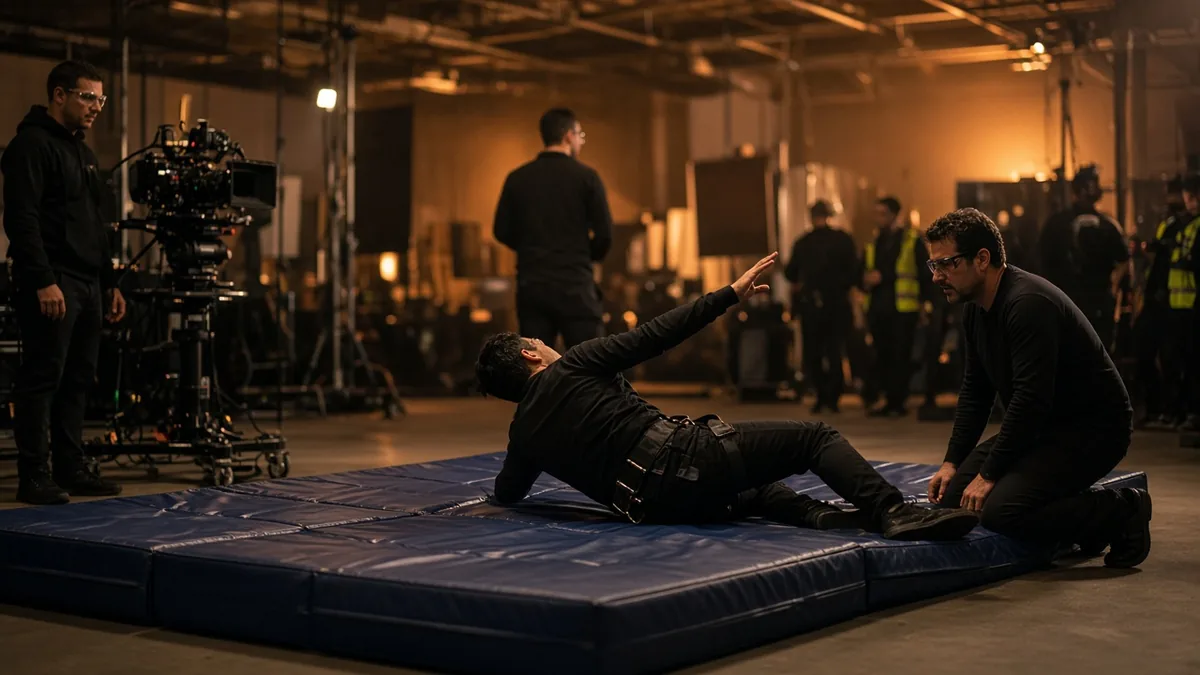
Knock-downs, trips, a shove into a mat, a fall from a chair. Simple to declare, but still planned, rehearsed and padded.
High falls: above 3 feet
Drops from platforms, stairs, balconies and scaffolds. Underwriters want the exact height, the landing system and the rig.
The height you declare is the height you shoot. If the fall gets higher on the day, update us before the take.
What underwriters want to know
- The height. Measured from the take-off point to the landing surface.
- The landing. Mats, stacked crash pads or an inflatable airbag, and who sets it up.
- The rigging. Harnesses, wires, descenders or decelerators, and who rigs and operates them.
- The people. Your stunt coordinator (always required) and the stunt performer doing the fall.
- The location. Interior set, exterior, rooftop or public space, and any permits.
What you'll need on set
A qualified coordinator
They plan the fall, choose the landing system and call the take.
The right landing
Mats for low falls; stacked pads or an airbag sized for the height for high falls.
Rigging and safety lines
For high falls, rigging set by a qualified rigger and checked before every take.
Rehearsals
Walk-throughs at lower heights first, then the full fall.
Medic on standby
Recommended for any high fall.
A clear set
Only the people who need to be there.
Real-world examples
The bar-fight knock-down
A performer is shoved over a table and lands on the floor. That is a low fall (3 feet or less) and, because there is contact, it is usually declared alongside a contact fight in the same scene.
The staircase tumble
A character falls down a flight of stairs. Even with padded steps, the total drop is well over 3 feet, so it is declared as a high fall, with the padding plan.
The balcony drop
A performer drops from a second-story balcony into an airbag. Underwriters will want the exact height, the airbag size, who rigs it and the rehearsal plan.
What a declaration looks like
An example of the details to send for one stunt scene (made up for illustration):
| Scene | 42: warehouse escape |
|---|---|
| Stunt | Performer drops from a 14-foot mezzanine into an airbag |
| Category | Fall, above 3 feet |
| Number of scenes | 1 (retakes included) |
| Dates | Shoot day 6 |
| Safety | Airbag sized for the height, rigger on set, two rehearsals at lower height, medic on standby |
Good to know
Stairs count as height
A fall down stairs is measured by the total drop, not one step.
Wire work
Falls on descenders or wires are still falls. Say so in the description.
Exterior heights
Rooftops and cliffs bring wind, light and access questions. Expect more detail to be asked for.
Common mistakes
Calling a fall "just a trip"
If a performer is meant to hit the ground on camera, declare it.
Raising the height on the day
A taller drop is a different stunt. Tell us before you shoot it.
Using an actor instead of a performer
If a principal actor does any part of the fall, tell us. See When an Actor Does the Stunt.
Mixing it with workers’ comp
Falls above 3 feet usually can’t share a policy with workers’ comp. See Stunts & Workers' Comp.
Watch: Falls & High Falls
Gaff explains how low falls and high falls are declared, and why the landing matters.
Common questions
Does a small fall need to be declared?
Yes. Any fall that is part of the action is a stunt, even a short one onto a mat.
What is the difference between a low fall and a high fall?
Underwriters usually split falls at 3 feet. Falls of 3 feet or less are low falls; anything higher is a high fall and needs more detail about the height, landing and rigging.
Do retakes count as extra falls?
No. Retakes of the same fall within one scene count as one stunt scene.
Can falls be on the same policy as workers’ comp?
Falls of 3 feet or less usually can. Higher falls usually cannot. Tell us both and we’ll help you set it up.
Do I need a stunt coordinator for a fall?
Yes. A qualified stunt coordinator is always required when stunts are declared.
How is fall height measured?
From the point the performer leaves to the landing surface.
Does an airbag change how a fall is declared?
No. The height decides the category. The airbag is part of the safety plan underwriters want to see.
Is falling into water a fall or a water stunt?
Often both. Describe it fully and we will declare it the right way. See the water page.
Ready to add your stunts?
Our team at MovieInsure places stunt coverage for productions of every size: short shoots, annual policies and features. Tell us what the stunt is and when you shoot, and we'll tell you what's needed.
Or call 1.888.959.0772 · quotes@movieinsure.com

More from the Stunt Library
How Stunt Insurance WorksFight ScenesWhen an Actor Does the StuntStunts & Workers' CompBefore Stunt Day: ChecklistCan't Be Insured vs. Needs Its Own Policy
StuntInsure.com is an educational site from MovieInsure.com, Inc., a licensed insurance agency (California License No. 0I32322). Coverage depends on the program, the policy and underwriting approval; this page explains how it usually works and is not a promise of coverage.