
-
9036 Reseda Blvd #105 Northridge, Ca 91324
-
Email Address quotes@movieinsure.com
-
Phone No 1.888.959.0772
Stunt Library · Cast
When an Actor Does the Stunt
Audiences love it when the star does their own stunts. Insurers look at it differently: if a principal actor is hurt, the whole production can stop. Here is how cast coverage and stunts fit together.
Key points
- Cast coverage protects the production if a key actor can’t work because of injury or illness.
- If a principal actor does any part of a stunt, tell us: it can change the cast coverage.
- Cast underwriters may exclude or add terms for an actor doing a stunt.
- Medicals may be required for covered cast.
- A stunt double in an identical costume is the simplest answer for most stunts.
What cast coverage doesWhen the actor does the stuntWhat underwriters want to knowReal-world examplesWhat a declaration looks likeGood to knowCommon mistakesVideoFAQ
What cast coverage does
Cast coverage pays the extra costs if a covered actor can’t work, for example reshooting or rescheduling. Covered actors are listed by name, role and date of birth, and medicals may be required.
Cast Extra Expense is a related option that covers extra costs when a cast member’s absence slows the production down, at different percentages.
When the actor does the stunt
Tell us early
Which actor, which stunt, which scenes.
Expect questions
Cast underwriters may exclude the stunt from cast coverage, or add terms.
Rehearse with the coordinator
Small, controlled stunts, matched to the actor’s skill.
Use a double for the big moments
The actor does the close-up, the double does the fall.
What underwriters want to know
- The actor. Name, role and date of birth.
- The stunt. Exactly which part of the stunt the actor does.
- Training. Rehearsals and any relevant experience.
- The double. Whether a stunt double does the riskier parts.
Real-world examples
The close-up jump
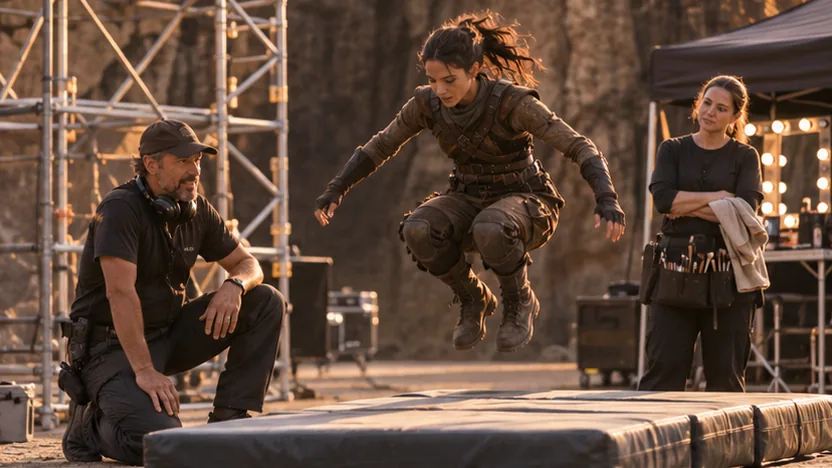
The lead actor jumps a short gap onto pads for a close-up, and the double does the wide shot. Tell us both.
The trained actor
An actor with martial-arts training wants to do their whole fight. It is possible, but cast underwriters may add terms.
The surprise on the day
An actor decides on set to do their own fall. Stop and call us first: it can change the cast coverage.
What a declaration looks like
An example of the details to send for one stunt scene (made up for illustration):
| Actor | Lead role (name, role and date of birth listed for cast coverage) |
|---|---|
| Stunt | Small rehearsed jump onto pads, close-up only |
| Double | Stunt double performs the wide shot and the landing roll |
| Medicals | May be required for covered cast |
| Safety | Coordinator spotting, two rehearsals, pads under the jump |
Good to know
Doubles and stand-ins
A stunt double is not the same as a stand-in.
Contracts
Actor contracts sometimes limit what stunts they can do.
Last-minute changes
Never swap the double for the actor on the day without telling us.
Common mistakes
Not telling us the actor does it
It can affect cast coverage.
Assuming cast coverage covers stunts
Stunts are declared on the production policy; cast coverage is about the actor’s availability.
Letting the actor "just try it"
Unrehearsed stunts are where injuries happen.
Watch: Your Actor Wants to Do the Stunt
Gaff explains what happens to cast coverage when an actor does their own stunt.
Common questions
Can an actor do their own stunts?
Yes, but tell us first. It can affect cast coverage, and underwriters may exclude the stunt or add terms.
What is cast coverage?
It covers the extra costs if a covered actor can’t work because of injury or illness. Medicals may be required.
What is Cast Extra Expense?
An option that covers extra costs when a cast member’s absence slows the production down.
Should we use a stunt double?
For anything beyond a small, rehearsed stunt, a double is usually the simplest and safest answer.
Will cast coverage pay if an actor is hurt doing a stunt?
It depends on the terms. Underwriters may exclude a stunt the actor does or add terms, so tell us in advance.
Do all actors need medicals?
Medicals may be required for covered cast.
Who decides if an actor can do a stunt?
The coordinator, the production and the underwriters together.
Ready to add your stunts?
Our team at MovieInsure places stunt coverage for productions of every size: short shoots, annual policies and features. Tell us what the stunt is and when you shoot, and we'll tell you what's needed.
Or call 1.888.959.0772 · quotes@movieinsure.com

More from the Stunt Library
How Stunt Insurance WorksStunts & Workers' CompFalls & High FallsFight ScenesBefore Stunt Day: ChecklistStunts by Program
StuntInsure.com is an educational site from MovieInsure.com, Inc., a licensed insurance agency (California License No. 0I32322). Coverage depends on the program, the policy and underwriting approval; this page explains how it usually works and is not a promise of coverage.