
-
9036 Reseda Blvd #105 Northridge, Ca 91324
-
Email Address quotes@movieinsure.com
-
Phone No 1.888.959.0772
Stunt Library · Start here
How Stunt Insurance Works
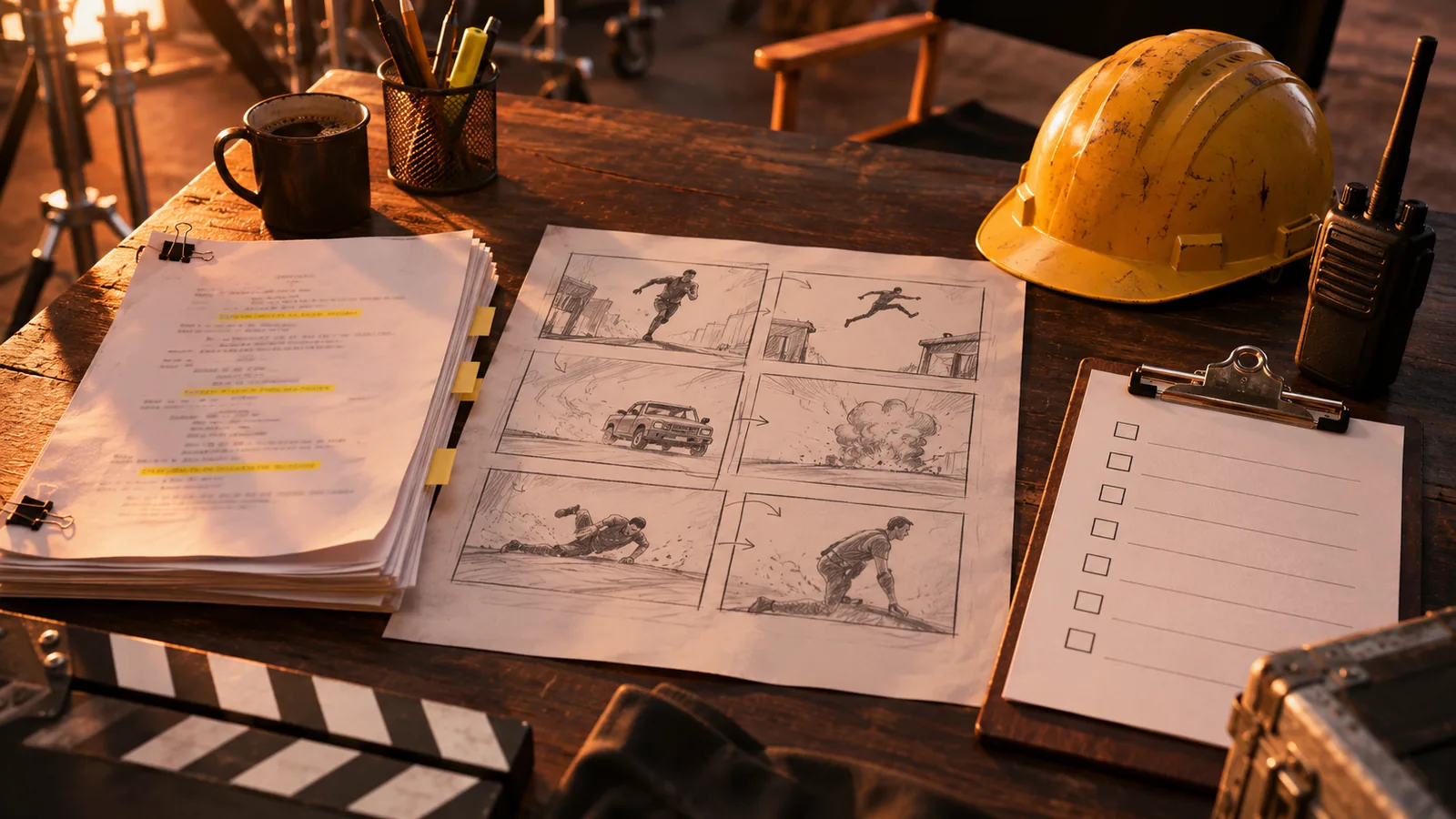
A production insurance policy does not cover stunts on its own. Each stunt is declared, scene by scene, and added to the policy before the camera rolls. Here is how that works, what underwriters want to know, and the mistakes that leave a stunt uncovered.
Key points
- Standard production policies exclude stunts until they are declared and added back.
- Stunts are added per scene: what the stunt is, how many scenes, and the shoot dates. Retakes of the same stunt in one scene count as one stunt scene.
- A stunt that was not declared, or that changes on the day, may not be covered.
- A qualified stunt coordinator is always required.
- Aircraft, boats and filming on an active railroad track need their own policy, which we arrange.
What stunt insurance actually isStunts are added scene by sceneThe main stunt categoriesWhat underwriters want to knowThings that need their own policyWorkers' comp and your castCommon mistakes that leave a stunt uncoveredVideoFAQ
What stunt insurance actually is
"Stunt insurance" is not usually a separate policy. It is coverage for stunts that is added onto your production policy: general liability, equipment, auto and the other parts of a film or TV package.
Almost every production policy has a stunt exclusion. Any stunt, pyrotechnic effect or animal action that is not declared is simply not covered. To cover it, the stunt is declared and scheduled on the policy, often called a stunt buyback or a schedule of covered stunts. Each declared stunt is then covered the way it was described.
In one sentence: you tell the insurer exactly which stunts you are doing, in which scenes and on which dates, and those stunts are added to the policy before you shoot.
Stunts are added scene by scene
Each stunt is declared as a stunt scene. For each one, expect to give:
- What the stunt is. A fall, a fight, a car chase, a fire effect, an animal action. The category matters, because each type is underwritten differently.
- How many scenes it appears in. Retakes of the same stunt inside one scene count as one stunt scene.
- The dates and location you will shoot it.
- The details that size the risk: the height of a fall, the number of vehicles, how close a pyro effect is to people, the type of animal.
Two of the same stunt in two different scenes are two stunt scenes. A big sequence with a fall, a fight and a vehicle hit is usually three stunt types, even if it is one scene.
The main stunt categories
Underwriters sort stunts into the same families on almost every program. Each one has its own page in this library:
Falls & High Falls
Low falls (3 ft or less) and high falls, onto pads, mats or an airbag.
Fight Scenes
Choreographed fights: no contact, contact, and fights with weapons.
Precision Driving, Chases & Crashes
Precision driving, chases, collisions and vehicle explosions.
Motorcycles & Recreational Vehicles
Motorcycles, ATVs, go-carts, snowmobiles, scooters and more.
Pyrotechnics, Explosions & Fire
Fireworks, explosions, fire effects and flash boxes.
Aerial: Helicopters, Planes & Balloons
Filming from helicopters and planes, balloons and parachutes.
Drones on Set
Camera drones on set, owned or rented.
Water Scenes & Boats
Pools, lakes, shorelines, surfing, kayaks, and boats.
Weapons, Blanks, Squibs & Prop Guns
Blanks, prop guns, knives, squibs and combinations.
Animals on Set
Dogs, horses, farm and zoo animals, and wild animals.
Railroad Scenes
Stations, inactive track and trains.
The same stunt list applies whether you are on a short-term policy, an annual (DICE) policy or a production portfolio policy. See Stunts by Program.
What underwriters want to know
Underwriters are not trying to stop the stunt. They want to see that it is planned and controlled. The more clearly you describe it, the smoother the approval.
The stunt
A plain description of the action, the scene numbers, heights, speeds, distances and how many takes you expect.
The people
Your stunt coordinator and their experience, the performers, and whether any principal actor is doing part of it.
The safety plan
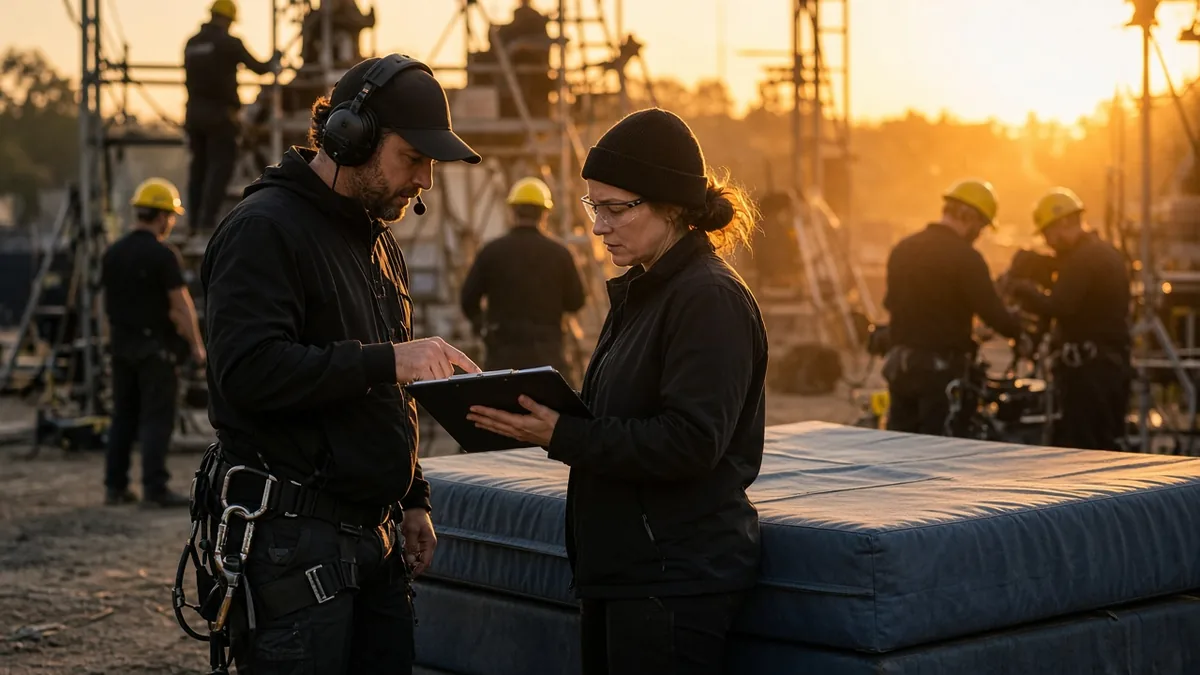
Pads, airbags, rigging, harnesses, rehearsals, and who calls "cut" if something is wrong.
The location
Closed set or public area, permits, road closures, and fire or medic standby where needed.
On bigger productions, expect a stunt questionnaire and a review of the marked script. Our Before Stunt Day: Checklist lists everything to have ready.
Things that need their own policy
Some things are not added as a stunt scene. They are placed on a separate policy alongside your production policy. We arrange these for you:
Aircraft
Helicopters, planes and the aircraft itself. The production policy covers filming the scene; the aircraft has its own aviation policy.
Boats
Watercraft used in or for the shoot need their own marine coverage.
Active railroad track
Filming on track that is in use needs an additional railroad policy. Stations and inactive track can usually be added as stunt scenes.
A short list of things can't be insured at all, such as venomous snakes and sharks. See Can't Be Insured vs. Needs Its Own Policy.
Workers' comp and your cast
Workers' comp: many stunt types cannot sit on the same policy as a production's workers' compensation. If you need both, tell us both and we'll help you set it up correctly. See Stunts & Workers' Comp.
Your actors: if a principal actor does any part of a stunt, tell us. It can affect cast coverage, and medicals may be required. See When an Actor Does the Stunt.
Common mistakes that leave a stunt uncovered
Skipping the "small" stunt
A shove into a wall, a short fall, a prop gun in the background. If it's a stunt, declare it.
Changing it on the day
A higher fall, an added fire effect, a faster car. Update us before you shoot, not after.
Declaring after the shoot
Coverage is set up before filming. A stunt added after the fact is not covered for what already happened.
No coordinator
A qualified stunt coordinator is always required, even for simple stunts.
Assuming workers' comp covers it
Some stunts and workers' comp can't share a policy. Ask first.
Forgetting the extras
The boat, the helicopter, the active track: these need their own policy.
Watch: Stunts Are Added Per Scene
Gaff explains how each stunt is declared scene by scene and added to a production policy.
Common questions
Does production insurance cover stunts automatically?
No. Most production policies exclude stunts. Each stunt has to be declared and added to the policy before it is filmed.
Is stunt insurance a separate policy?
Usually not. Stunts are added to your production policy as declared stunt scenes. Aircraft, boats and filming on an active railroad track are the exceptions: those need their own policy, which we arrange.
How are stunts counted?
Per stunt scene. Each scene with a stunt is declared. Retakes of the same stunt within one scene count as one stunt scene.
Do I need a stunt coordinator?
Yes. A qualified stunt coordinator is always required when stunts are declared.
What if the stunt changes on the day?
Tell us before you shoot it. A stunt is covered as it was declared; a bigger or different stunt may not be.
Can I add a stunt after filming?
No. Coverage is arranged before the stunt is filmed.
Do short-term, annual and portfolio policies cover different stunts?
The stunt types are the same across all three. What changes is how they are added: online scene by scene on a short-term policy, scheduled per shoot on an annual policy, and reviewed with the script on larger productions.
Ready to add your stunts?
Our team at MovieInsure places stunt coverage for productions of every size: short shoots, annual policies and features. Tell us what the stunt is and when you shoot, and we'll tell you what's needed.
Or call 1.888.959.0772 · quotes@movieinsure.com

More from the Stunt Library
Falls & High FallsFight ScenesPrecision Driving, Chases & CrashesPyrotechnics, Explosions & FireStunts & Workers' CompCan't Be Insured vs. Needs Its Own PolicyBefore Stunt Day: ChecklistStunts by Program
StuntInsure.com is an educational site from MovieInsure.com, Inc., a licensed insurance agency (California License No. 0I32322). Coverage depends on the program, the policy and underwriting approval; this page explains how it usually works and is not a promise of coverage.