
-
9036 Reseda Blvd #105 Northridge, Ca 91324
-
Email Address quotes@movieinsure.com
-
Phone No 1.888.959.0772
Stunt Library · Aerial
Aerial: Helicopters, Planes & Balloons
Shooting from the air, or putting performers in the air, is two separate things to insure: the scene on your production policy, and the aircraft on its own aviation policy.
Key points
- Aerial scenes include airplanes, helicopters, hang gliders, parachutes and hot air balloons.
- The scene is declared on your production policy as a stunt.
- The aircraft needs its own aviation policy, normally carried by the operator. We arrange what’s needed.
- Use licensed pilots and experienced aerial operators.
- Camera drones have their own page: Drones on Set.
What countsTwo things to insure: the scene and the aircraftWhat underwriters want to knowWhat you'll need on setReal-world examplesWhat a declaration looks likeGood to knowCommon mistakesVideoFAQ
What counts
Airplanes
Jets, private and prop planes, and airline settings used in a scene.
Helicopters
Camera ships, performers riding or hanging from a helicopter, and landings on location.
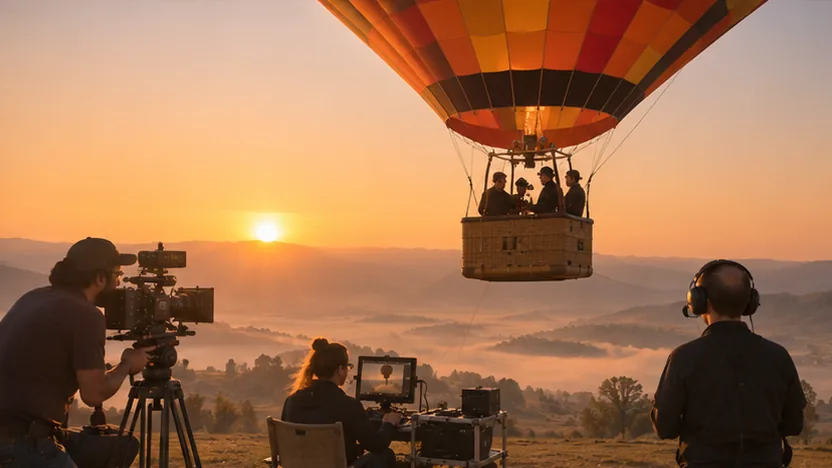
Balloons, hang gliders and parachutes
Performers or camera operators in the air without an engine, or jumping from one.
Two things to insure: the scene and the aircraft
The scene
Added to your production policy as a declared aerial stunt scene, like any other stunt.
The aircraft
The aircraft itself is covered by its own aviation policy, usually through the operator. Your production policy does not cover the aircraft.
Ask the operator for their aviation insurance certificate naming your production. If anything is missing, we arrange the extra policy.
What underwriters want to know
- The aircraft. Type of aircraft and its value range.
- The action. Shooting from the aircraft, performers on or near it, or a jump.
- The operator. The company, the pilot’s license and experience, and their insurance.
- The location. Where it takes off, lands and flies, and any permits.
What you'll need on set
A licensed operator
With aviation insurance and experience in film work.
Harnesses and tethers
For any camera operator shooting from an open door.
A ground safety plan
Landing zones kept clear and a safety briefing for everyone near the aircraft.
Weather calls
A go / no-go decision made by the pilot.
Real-world examples
The helicopter camera ship
A camera operator shoots a car chase from a helicopter. The aerial scene is declared on the production policy, and the helicopter is covered by the operator's aviation policy.
The private jet interior
Actors film a scene inside a parked private jet. That is an airplane scene; tell us whether the aircraft moves.
The parachute landing
A skydiver lands in frame. That is an aerial stunt with a specialist jumper and their own insurance.
What a declaration looks like
An example of the details to send for one stunt scene (made up for illustration):
| Scene | 3: opening aerial |
|---|---|
| Stunt | Helicopter camera ship following a car along a coastal road |
| Category | Aerial: helicopter |
| Aircraft | Operator-supplied helicopter, operator's aviation certificate naming the production |
| Dates | Shoot day 1 |
| Safety | Licensed pilot, harnessed camera operator, ground safety plan, weather call by the pilot |
Good to know
Parked aircraft
A plane on the ground with no engines running is still worth mentioning.
Airports
Airports and airfields have their own access and insurance requirements.
Weather days
Build weather days into the schedule.
Common mistakes
Assuming the production policy covers the aircraft
It doesn’t. The aircraft needs its own policy.
Forgetting the scene itself
The aerial scene still has to be declared on the production policy.
No certificate from the operator
Get it before the shoot day.
Watch: Shooting From the Air
Gaff explains why an aerial scene and the aircraft are insured separately.
Common questions
Does my production policy cover the helicopter?
No. The aircraft needs its own aviation policy, usually through the operator. The scene is declared on your production policy.
Is filming from a helicopter a stunt?
Yes. Aerial scenes are declared as stunt scenes on the production policy.
Are hot air balloons and parachutes covered?
They can be declared as aerial stunt scenes. The balloon or aircraft has its own policy.
What about drones?
Camera drones are handled differently. See the drones page in this library.
Is filming inside a parked plane an aerial stunt?
Tell us. A parked aircraft is lower risk, but the scene and the aircraft both matter.
Who insures the helicopter?
The operator, through its own aviation policy. Ask for a certificate naming your production.
Do I need permits for aerial filming?
Often yes, depending on where you fly. The operator will usually help.
Ready to add your stunts?
Our team at MovieInsure places stunt coverage for productions of every size: short shoots, annual policies and features. Tell us what the stunt is and when you shoot, and we'll tell you what's needed.
Or call 1.888.959.0772 · quotes@movieinsure.com

More from the Stunt Library
Drones on SetHow Stunt Insurance WorksCan't Be Insured vs. Needs Its Own PolicyWater Scenes & BoatsBefore Stunt Day: ChecklistStunts by Program
StuntInsure.com is an educational site from MovieInsure.com, Inc., a licensed insurance agency (California License No. 0I32322). Coverage depends on the program, the policy and underwriting approval; this page explains how it usually works and is not a promise of coverage.