
-
9036 Reseda Blvd #105 Northridge, Ca 91324
-
Email Address quotes@movieinsure.com
-
Phone No 1.888.959.0772
Stunt Library · Weapons
Weapons, Blanks, Squibs & Prop Guns
Any weapon on set, real-looking or obviously fake, is a safety question first and an insurance question second. Here is how weapons scenes are declared and what underwriters expect to see.
Key points
- Weapons scenes include blanks, prop guns, knives, squibs, or a combination.
- An armorer or qualified weapons handler should control every weapon on set.
- Weapons are never pointed at anyone. Camera angles and effects sell the shot.
- A fight that uses a weapon is declared as a fight with weapons. See Fight Scenes.
- Squibs and bullet hits are also effects. See Pyrotechnics, Explosions & Fire.
What countsThe armorer runs the weaponsWhat underwriters want to knowWhat you'll need on setReal-world examplesWhat a declaration looks likeGood to knowCommon mistakesVideoFAQ
What counts
Blanks
Firearms loaded with blank rounds for muzzle flash and sound.
Prop guns
Non-firing replicas, rubber or resin guns, and disabled firearms.
Knives and blades
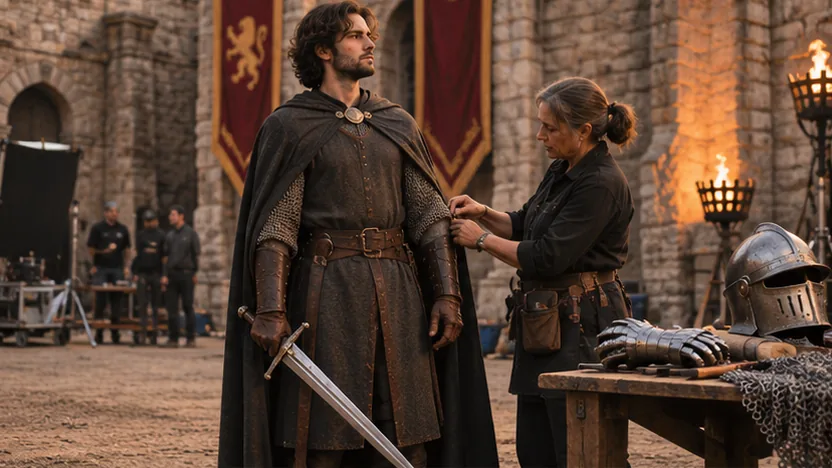
Swords, knives and other edged props, including blunted and rubber versions.
Squibs
Small charges that simulate bullet hits on sets, props or costumes.
Combinations
Scenes that mix several of these.
The armorer runs the weapons
A qualified armorer (or weapons specialist) controls every weapon on set: storage, loading, handing it to the actor, taking it back after the take and checking it in between. Underwriters expect one for anything beyond a simple rubber prop.
Safety basics: treat every weapon as real, never point a weapon at a person (including the camera crew), keep weapons locked up when not in use, and hold a safety briefing before any weapons scene.
What underwriters want to know
- The weapons. Blanks, prop guns, blades, squibs or a combination, and how many.
- The armorer. Who controls the weapons, and their qualifications.
- The action. Firing, holding, fighting, or bullet hits.
- Distances. How close blanks and squibs are to cast and crew.
- The location. Closed set or public area, and local permits or police notice.
What you'll need on set
A qualified armorer
In charge of every weapon, every take.
A safety briefing
Before the scene, for everyone on set.
Ear and eye protection
For anyone near blanks or squibs.
Secure storage
Locked up when not in use.
Real-world examples
The holstered prop
A detective wears a rubber prop gun in a holster and never draws it. Tell us: it is the simplest weapons case, but it is still a weapon on set.
The shootout
Blank-firing weapons and squib hits on a set wall. That is a weapons scene with blanks and squibs, run by an armorer with ear and eye protection for everyone nearby.
The knife threat
A character holds a knife to another's throat. A blunted or rubber knife, rehearsed with the coordinator, and declared as a weapons scene (and a fight with weapons if there is contact).
What a declaration looks like
An example of the details to send for one stunt scene (made up for illustration):
| Scene | 48: bank shootout |
|---|---|
| Stunt | Four performers firing blanks, squib hits on set walls |
| Category | Weapons: combination (blanks and squibs) |
| Number of scenes | 1 |
| Dates | Shoot day 12 |
| Safety | Armorer controlling all weapons, safety briefing, ear and eye protection, weapons never pointed at people |
Good to know
Public locations
Weapons scenes in public places usually need police notice so nobody calls 911.
Transport
Weapons travel to and from set with the armorer, not the actors.
Real firearms
Real firearms on set need extra care and qualified handling. Tell us before you plan it.
Common mistakes
"It’s only a prop"
Declare every weapons scene, even with fake weapons.
No armorer
Underwriters expect a qualified person controlling the weapons.
Aiming at a person
Never. Use angles and effects instead.
Forgetting the squibs
Bullet hits are effects too.
Watch: Weapons, Blanks & Prop Guns
Gaff explains how weapons scenes are declared and why the armorer matters.
Common questions
Do fake weapons need to be declared?
Yes. Any weapons scene is declared, whether the weapons fire blanks or are rubber props.
Do I need an armorer?
Underwriters expect a qualified armorer or weapons handler controlling weapons on set.
Are squibs a weapon or an effect?
Both. Squibs are declared with the weapons scene and follow the effects rules.
What if a weapon is used in a fight?
Declare the fight as a fight with weapons.
Does a holstered prop gun need to be declared?
Yes. Any weapon on set should be declared, even if it is never drawn.
Who can handle blanks?
A qualified armorer controls blank-firing weapons at all times.
Do we need to tell the police?
For weapons scenes in public places, police notice is common and often required by the permit.
Ready to add your stunts?
Our team at MovieInsure places stunt coverage for productions of every size: short shoots, annual policies and features. Tell us what the stunt is and when you shoot, and we'll tell you what's needed.
Or call 1.888.959.0772 · quotes@movieinsure.com

More from the Stunt Library
Fight ScenesPyrotechnics, Explosions & FireHow Stunt Insurance WorksBefore Stunt Day: ChecklistWhen an Actor Does the StuntStunts & Workers' Comp
StuntInsure.com is an educational site from MovieInsure.com, Inc., a licensed insurance agency (California License No. 0I32322). Coverage depends on the program, the policy and underwriting approval; this page explains how it usually works and is not a promise of coverage.