-
9036 Reseda Blvd #105 Northridge, Ca 91324
-
Email Address quotes@movieinsure.com
-
Phone No 1.888.959.0772
Stunt Library · Drones
Drones on Set
Drones are now on almost every shoot. They are declared like a stunt, but the questions are about the pilot, the drone and the location rather than a performer.
Key points
- Drone shots are declared, whether the drone is owned or rented.
- Small camera drones flown within the pilot’s line of sight are the usual case.
- The pilot should be FAA Part 107 certified, and locations often ask for proof.
- Coverage may be available for the drone and camera too, if you add it.
- Drones can usually sit alongside workers’ comp.
Two parts: liability and the droneWhat underwriters want to knowWhat you'll need on setReal-world examplesWhat a declaration looks likeGood to knowCommon mistakesVideoFAQ
Two parts: liability and the drone
Liability
Injury to people or damage to property caused by the drone. This is what locations care about most.
The drone and camera
Coverage for the drone, camera and gimbal themselves, if you add it.
Most location owners will want a certificate of insurance naming them, and proof that the pilot is certified. Ask about this early.
What underwriters want to know
- Owned or rented. Whose drone it is, and its value.
- The drone. Size and type. Small camera drones are the usual case; larger rigs get a closer look.
- The pilot. FAA Part 107 certification and experience, plus a visual observer.
- The flight. Height, distance and whether the drone stays in line of sight.
- The location. Over crew only, over private land, or near the public, and any permits.
What you'll need on set
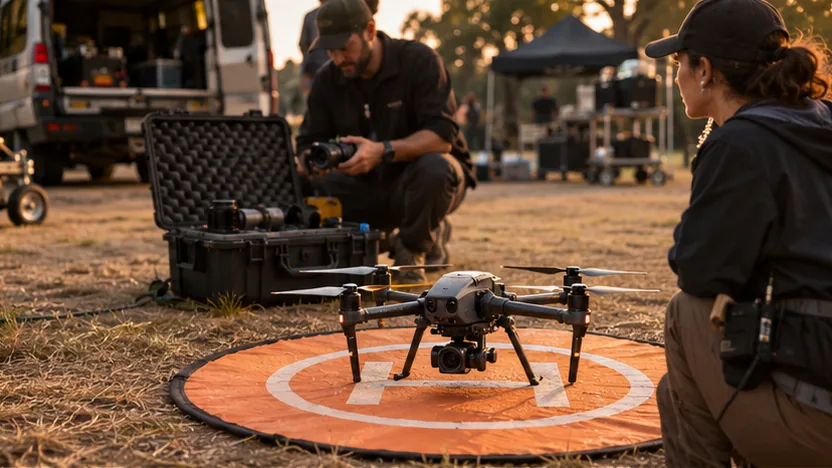
A certified pilot
FAA Part 107, with the certificate on hand.
A visual observer
A spotter who keeps eyes on the drone.
A landing zone
Clear of crew and equipment.
Location paperwork
Certificates of insurance naming the location, and any permits.
Real-world examples
The establishing shot
A drone rises over a house at sunset. Simple, but still declared, with the pilot's certificate and the location's permission.
The chase follow
A drone follows a car on a closed road. The drone stays in line of sight, with an observer, and the driving is declared separately.
The rented drone
A production rents a drone with a pilot. The drone is declared as rented, and the rental company may want proof of coverage for its drone.
What a declaration looks like
An example of the details to send for one stunt scene (made up for illustration):
| Scene | 1: opening aerials |
|---|---|
| Stunt | Drone flyover of a ranch house and fields |
| Category | Drone, rented |
| Pilot | FAA Part 107 certified, with a visual observer |
| Dates | Shoot day 1 |
| Safety | Line of sight at all times, landing zone kept clear, location certificate issued |
Good to know
Over crowds
Flying over people brings extra rules. Plan routes over crew only.
Indoor drones
Indoor flights still count; tell us.
Batteries
Battery handling and charging are part of good drone safety.
Common mistakes
Not declaring a "quick" drone shot
Every drone flight on the shoot should be declared.
Flying out of line of sight
Keep the drone where the pilot can see it.
Assuming the drone itself is covered
Equipment coverage for the drone is added separately.
Watch: Drone Insurance for Film Shoots
Cam explains drone liability, coverage for the drone and camera, and what locations ask for.
Common questions
Do I need to declare a drone shot?
Yes. Drone filming is declared whether the drone is owned or rented.
Does the pilot need to be certified?
Pilots should be FAA Part 107 certified, and locations often ask for proof.
Is the drone itself covered?
Coverage for the drone, camera and gimbal may be available if you add it. Liability is the core coverage.
Can drones go on the same policy as workers’ comp?
Usually yes. Drones are one of the categories that can sit alongside workers’ comp.
Is a drone shot over my own property a stunt?
It should still be declared, with the pilot's details.
What do locations ask for?
Usually a certificate of insurance naming them, and the pilot's FAA Part 107 certificate.
Can we fly indoors?
Yes, with the same declaration and safety planning.
Ready to add your stunts?
Our team at MovieInsure places stunt coverage for productions of every size: short shoots, annual policies and features. Tell us what the stunt is and when you shoot, and we'll tell you what's needed.
Or call 1.888.959.0772 · quotes@movieinsure.com

More from the Stunt Library
Aerial: Helicopters, Planes & BalloonsHow Stunt Insurance WorksStunts & Workers' CompBefore Stunt Day: ChecklistStunts by ProgramWater Scenes & Boats
StuntInsure.com is an educational site from MovieInsure.com, Inc., a licensed insurance agency (California License No. 0I32322). Coverage depends on the program, the policy and underwriting approval; this page explains how it usually works and is not a promise of coverage.