
-
9036 Reseda Blvd #105 Northridge, Ca 91324
-
Email Address quotes@movieinsure.com
-
Phone No 1.888.959.0772
Stunt Library · Pyro
Pyrotechnics, Explosions & Fire Effects
Fireworks, explosions, fire effects and flash boxes are some of the most closely underwritten items on a production. The key questions: who is running the effect, and how close it is to people.
Key points
- Pyro covers fireworks, explosions, demolitions, fire effects and flash boxes.
- Effects must be run by a licensed pyrotechnician.
- Underwriters rate pyro by how close the effect is to people.
- If the pyrotechnician’s own insurance certificate names your production, that usually makes it simpler.
- Pyro can’t share a policy with workers’ comp. See Stunts & Workers' Comp.
What counts as pyroDistance from people is everythingWhat underwriters want to knowWhat you'll need on setReal-world examplesWhat a declaration looks likeGood to knowCommon mistakesVideoFAQ
What counts as pyro
Fireworks
Aerial or ground fireworks used in a scene.
Explosions and demolitions
Explosive effects, bullet hits on sets, building or vehicle effects.
Fire effects
Controlled flames, fire bars, burning props and sets. A performer on fire is a burn stunt with its own specialists.
Flash boxes
Small flash and smoke effects. Declared as their own type.
Distance from people is everything
Underwriters group pyro by how close the effect is to cast, crew and the public. The levels run from far away (about 500 feet) through 250 feet and 100 feet down to close effects near performers. The closer it is, the more detail they need.
The pyro certificate: licensed pyrotechnicians carry their own insurance. If their certificate names your production as covered, that usually makes adding the effect simpler. Ask your pyrotechnician for it early.
What underwriters want to know
- The effect. What it is, how big, and how many.
- The pyrotechnician. Their license and experience, and their insurance certificate.
- The distance. How close the effect is to cast, crew, the public and buildings.
- Fire department. Permits, fire marshal sign-off and fire standby on the day.
- The location. Stage, backlot, open land or public area.
What you'll need on set
A licensed pyrotechnician
Licensed for the type of effect and the state you shoot in.
Permits and fire standby
From the local fire authority, usually with a fire crew on set.
Barriers and distances
Marked safe zones for crew and cameras.
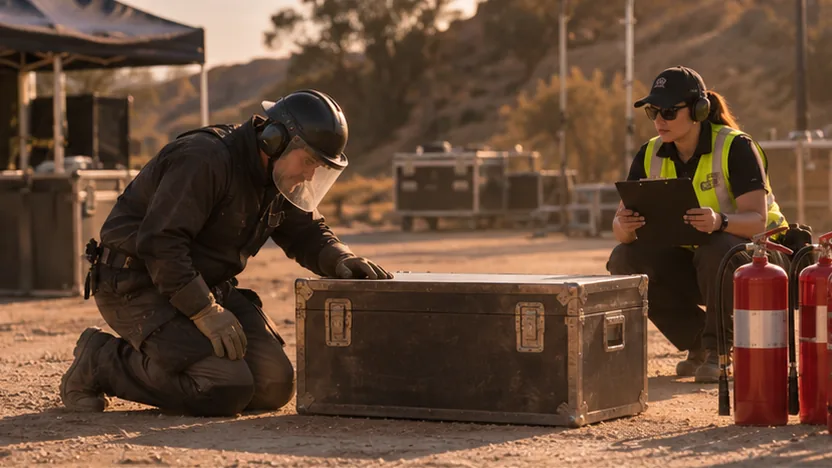
Extinguishers and a safety officer
Ready before every take, plus a medic.
Real-world examples
The muzzle-flash firefight
Several blank-firing weapons with bullet hits on a wall. That is a weapons scene with squibs, run by the armorer and the pyrotechnician.
The car explosion
A prepared car explodes in an open lot. That is pyro and a vehicle explosion, with distance, fire standby and permits all declared.
The fireplace and candles
A controlled fire effect on set. It is still a fire effect: declare it, with an extinguisher and a safety person nearby.
What a declaration looks like
An example of the details to send for one stunt scene (made up for illustration):
| Scene | 55: warehouse explosion |
|---|---|
| Stunt | Controlled explosion behind a performer running toward camera |
| Category | Pyrotechnics: explosion |
| Distance | Effect about 100 feet from the performer, crew behind barriers |
| Dates | Shoot day 14 |
| Safety | Licensed pyrotechnician with certificate naming the production, fire department standby, permits, medic |
Good to know
Smoke and haze
Atmospheric smoke is usually not pyro. Flash, flame and explosive effects are.
Digital vs. practical
If an explosion will be added in post, there is nothing to declare for it.
Neighbors
Effects near homes or roads usually need notice and permits.
Common mistakes
Using an unlicensed effects person
Pyro must be handled by a licensed pyrotechnician.
Moving the effect closer on the day
Distance changes the risk. Update us first.
Forgetting the vehicle explosion
A car explosion is also a driving stunt. See Precision Driving, Chases & Crashes.
Pyro on the workers’ comp policy
They can’t share a policy. Tell us both and we’ll help.
Watch: Fire on Set: Pyro & Explosions
Gaff explains how pyro is rated by distance and why the pyrotechnician matters.
Common questions
Does a small flash effect count as pyro?
Yes. Flash boxes and small effects are declared as their own type.
Do I need a licensed pyrotechnician?
Yes. Effects must be run by a licensed pyrotechnician.
Why does distance matter?
Underwriters rate pyro by how close the effect is to people. Closer effects need more detail and review.
What is the pyro certificate?
Proof of the pyrotechnician’s own insurance. If it names your production, adding the effect is usually simpler.
Can pyro go on the same policy as workers’ comp?
No. Tell us you need both and we’ll help you set it up.
Do I need to declare effects added in post?
No. Only practical effects on set are declared.
Is a smoke machine pyro?
Usually not. Flash, flame and explosive effects are.
Who gets the fire permit?
Usually the production or the pyrotechnician arranges it with the local fire authority.
Ready to add your stunts?
Our team at MovieInsure places stunt coverage for productions of every size: short shoots, annual policies and features. Tell us what the stunt is and when you shoot, and we'll tell you what's needed.
Or call 1.888.959.0772 · quotes@movieinsure.com

More from the Stunt Library
Precision Driving, Chases & CrashesHow Stunt Insurance WorksWeapons, Blanks, Squibs & Prop GunsStunts & Workers' CompBefore Stunt Day: ChecklistCan't Be Insured vs. Needs Its Own Policy
StuntInsure.com is an educational site from MovieInsure.com, Inc., a licensed insurance agency (California License No. 0I32322). Coverage depends on the program, the policy and underwriting approval; this page explains how it usually works and is not a promise of coverage.