
-
9036 Reseda Blvd #105 Northridge, Ca 91324
-
Email Address quotes@movieinsure.com
-
Phone No 1.888.959.0772
Stunt Library · Fights
Fight Scene Stunts
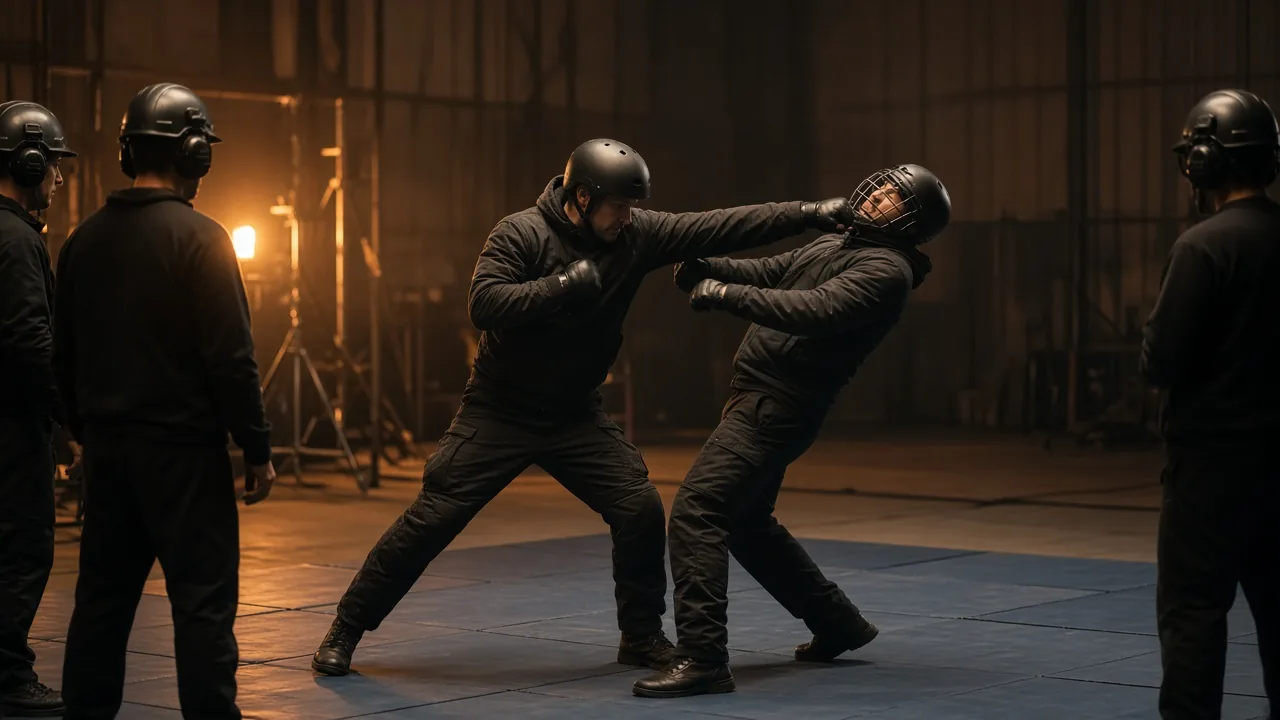
A choreographed fight looks chaotic on screen but is carefully planned behind the camera. Underwriters sort fights by how much contact there is and whether weapons are involved. Here is how each level is declared.
Key points
- Fight scenes are declared in three levels: no contact, contact without weapons, and contact with weapons.
- Every fight should be choreographed and rehearsed, led by your stunt coordinator or a fight choreographer.
- If a weapon is used, even a prop, the fight is the weapons level. See Weapons, Blanks, Squibs & Prop Guns.
- Pulled punches and camera angles sell the hit. Performers should not actually be struck.
- Retakes of the same fight in one scene count as one stunt scene.
The three levels of fightWhat underwriters want to knowWhat you'll need on setReal-world examplesWhat a declaration looks likeGood to knowCommon mistakesVideoFAQ
The three levels of fight
No contact
Punches and kicks that never land: the camera angle and sound sell the hit. The simplest level to declare.
Contact, no weapons
Grabs, shoves, throws and holds where performers do touch, but nobody is struck for real.
Contact with weapons
Any fight that includes a weapon: prop knives, swords, bats, prop guns or improvised objects.
Tip: declare the highest level the fight reaches. A brawl that ends with a bottle swing is a weapons fight.
What underwriters want to know
- The choreography. What happens, beat by beat, and how long the fight runs.
- The level. No contact, contact, or with weapons, and which weapons.
- The people. Your stunt coordinator or fight choreographer, and the performers (and whether any principal actor fights).
- The surface. Mats or padded flooring where falls or throws happen.
- Rehearsal time. How many rehearsals before the shoot day.
What you'll need on set
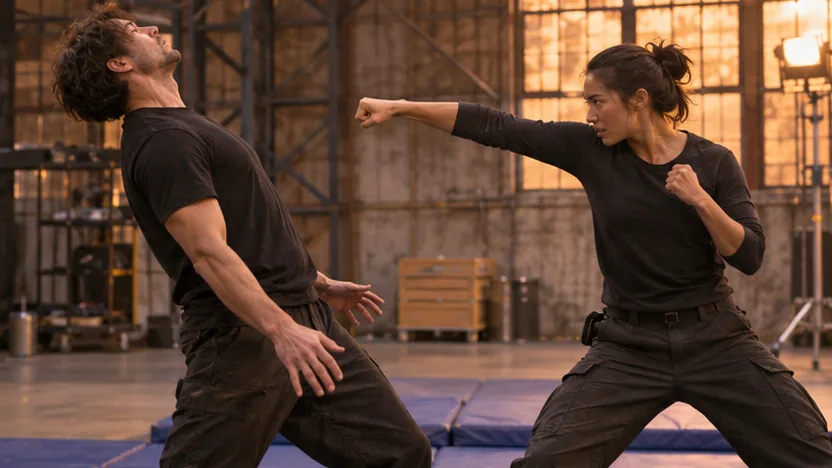
A coordinator or fight choreographer
Designs the fight around the performers’ skills and the camera.
Rehearsals at speed
Slow first, then full speed only once everyone knows every beat.
Padding
Mats where anyone lands, and pads under costumes where needed.
Soft or blunted props
Rubber or foam versions for close contact. A weapons specialist or armorer for anything else.
Real-world examples
The slap
One actor slaps another. Even a single slap is contact. Most productions use a stunt slap technique and rehearse it, and it is declared as a contact fight.
The street brawl
Four performers trade punches and throws, and one is thrown onto the hood of a parked car. That is a contact fight, plus a fall if the throw is high.
The sword duel
Two performers fight with blunted swords on a castle set. That is a fight with weapons, run with an armorer or weapons specialist and a fight choreographer.
What a declaration looks like
An example of the details to send for one stunt scene (made up for illustration):
| Scene | 18: parking-garage fight |
|---|---|
| Stunt | Three-person fight, punches pulled, one performer thrown onto mats |
| Category | Fight, contact without weapons |
| Number of scenes | 1 |
| Dates | Shoot day 3 |
| Safety | Fight choreographer, two full rehearsals, mats under the throw, coordinator calling cut |
Good to know
Background fights count too
A brawl behind the main action is still a fight scene.
Close-ups vs. wide shots
Wider shots often need more contact to read on camera. Plan the level for the widest shot.
Costumes and pads
Hidden pads under costumes are common for contact fights.
Common mistakes
Under-declaring the level
A "no contact" fight that ends with a tackle is a contact fight.
Adding a weapon on the day
A prop bottle or knife changes the level. Tell us first.
Skipping rehearsal
Most fight injuries come from moves that were not rehearsed at speed.
Actors improvising
Keep to the choreography. If a principal actor fights, see When an Actor Does the Stunt.
Watch: Fight Scenes
Gaff explains the three levels of fight scene and why the weapons level matters.
Common questions
Does a fight with no contact need to be declared?
Yes. Any choreographed fight is a stunt, even if no punch lands.
What if a prop weapon is used in the fight?
Then it is declared as a fight with weapons, and the weapon itself follows the weapons rules. See the weapons page in this library.
Do I need a fight choreographer?
A qualified stunt coordinator is always required. Many productions also bring in a fight choreographer for complex fights.
Is each punch a separate stunt?
No. The fight is declared per scene. Retakes of the same fight in one scene count as one stunt scene.
Is a slap a stunt?
Yes. Any contact on camera is declared as a contact fight, even a single slap.
What if the fight includes a fall?
Declare both. A big throw or a fall onto the floor may also be a fall stunt.
Can actors do their own fights?
Yes, with rehearsal and the coordinator, but tell us. It can affect cast coverage.
Ready to add your stunts?
Our team at MovieInsure places stunt coverage for productions of every size: short shoots, annual policies and features. Tell us what the stunt is and when you shoot, and we'll tell you what's needed.
Or call 1.888.959.0772 · quotes@movieinsure.com

More from the Stunt Library
How Stunt Insurance WorksWeapons, Blanks, Squibs & Prop GunsFalls & High FallsWhen an Actor Does the StuntBefore Stunt Day: ChecklistPrecision Driving, Chases & Crashes
StuntInsure.com is an educational site from MovieInsure.com, Inc., a licensed insurance agency (California License No. 0I32322). Coverage depends on the program, the policy and underwriting approval; this page explains how it usually works and is not a promise of coverage.