
-
9036 Reseda Blvd #105 Northridge, Ca 91324
-
Email Address quotes@movieinsure.com
-
Phone No 1.888.959.0772
Stunt Library · Reference
Stunt Insurance FAQ & Glossary
Quick answers about how stunts are insured on film and TV productions, plus plain-English definitions of the coverage terms you'll see on a quote or certificate.
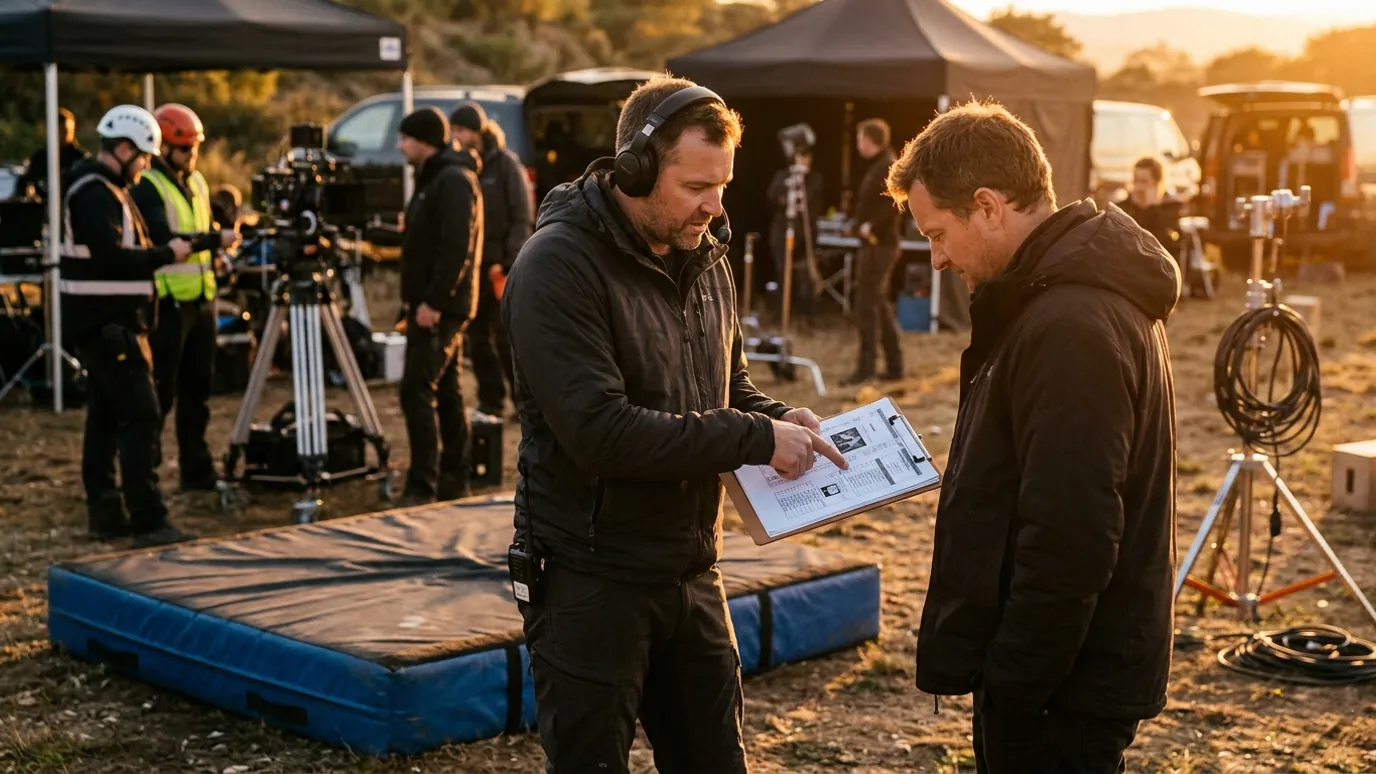
Stunts
Does production insurance cover stunts automatically?
No. Production policies exclude stunts until each one is declared and added to the policy. See How Stunt Insurance Works.
How are stunts counted?
Per stunt scene. Each scene with a stunt is declared with its category, number of scenes and dates. Retakes of the same stunt within one scene count as one stunt scene.
Is a stunt coordinator required?
Yes. A qualified stunt coordinator is always required when stunts are declared.
Can I add a stunt after filming?
No. Stunts are declared and added before they are filmed, and covered the way they were declared.
Are squibs and blanks covered?
They can be declared as a weapons scene (blanks, prop guns, knives, squibs or a combination), with an armorer controlling the weapons. See Weapons, Blanks, Squibs & Prop Guns.
Are flash boxes covered?
Yes. Flash boxes are declared as their own effect type. See Pyrotechnics, Explosions & Fire.
Can an actor do their own stunt?
Tell us first. Cast underwriters may exclude the stunt or add terms, and medicals may be required for covered cast. See When an Actor Does the Stunt.
Can stunts share a policy with workers' comp?
Some can (falls of 3 feet or less, drones, pets, allowed dogs, farm animals other than horses, caged zoo animals, wild birds). Most others can't. Tell us both and we'll help you set it up. See Stunts & Workers' Comp.
What needs its own policy?
Aircraft, boats and filming on an active railroad track. We arrange these alongside your production policy. See Can't Be Insured vs. Needs Its Own Policy.
Are the stunt types different on short-term, annual and portfolio policies?
No, the categories are the same. How they are added differs. See Stunts by Program.
Short Term program basics
Where does a Short Term policy apply?
In the United States and Canada only. Shoots in other countries need a different program.
Can coverage be backdated?
No. Coverage starts once it is bound, never before. Bind before your first shoot day.
Can I change a policy after it expires?
No. Make any changes, including added stunts or dates, while the policy is still active.
Glossary of coverage terms
Additional insured
A person or company, such as a location owner or permit office, added to your liability coverage for claims arising from your production. Usually shown on a certificate of insurance.
Cast coverage
Pays extra costs if a covered actor can’t work because of injury or illness. Covered actors are listed by name, role and date of birth; medicals may be required.
Cast Extra Expense
Covers extra costs when a cast member’s absence slows the production down.
Certificate of insurance (COI)
A document showing your coverage, issued to locations, vendors and permit offices. Some cities require special wording or their own form.
Declared stunt
A stunt you have described to the insurer (category, scenes, dates) and that has been added to your policy.
Equipment, props, sets & wardrobe
Covers physical damage to production property, such as cameras, lights, props, sets and wardrobe, while in your care.
Excess liability
Extra liability limits above your general liability and auto coverage, often required by bigger locations.
Extra expense
Covers extra costs to keep shooting after a covered loss, for example renting replacement gear.
General liability
Covers claims for bodily injury or property damage to third parties caused by your production.
Hired & non-owned auto
Liability for vehicles you rent or that crew use for the production; physical damage covers the rented vehicles themselves.
Loss payee
A vendor, such as a rental house, named to receive payment if their equipment is damaged.
Negative film & faulty stock
Covers loss of footage caused by damaged or faulty stock, cameras or processing.
Railroad Protective Liability
A separate policy that protects a railroad when you film on or near its property. Railroads almost always ask for it.
Schedule of covered stunts
The list of declared stunts, animals or pyro added to a policy, especially on annual (DICE) policies. Also called a stunt buyback.
Stunt coordinator
The qualified professional who plans and supervises every stunt. Always required.
Stunt exclusion
The part of a production policy that removes coverage for stunts until they are declared and added back.
Stunt scene
One scene that includes a stunt. The unit stunts are declared in; retakes inside the scene count once.
Third-party property damage
Covers damage to property you don’t own, such as a location or a neighbor’s building, caused by your production.
Waiver of subrogation
An agreement, often required by locations, that your insurer won’t seek to recover a paid claim from them.
Workers' compensation
Covers medical costs and lost wages for workers injured on the job, as required by state law. Many stunts can’t sit on the same policy.
Go deeper: the Stunt Library
How Stunt Insurance WorksFalls & High FallsFight ScenesPrecision Driving, Chases & CrashesMotorcycles & Recreational VehiclesPyrotechnics, Explosions & FireAerial: Helicopters, Planes & BalloonsDrones on SetWater Scenes & BoatsWeapons, Blanks, Squibs & Prop GunsAnimals on SetRailroad ScenesStunts & Workers' CompWhen an Actor Does the StuntCan't Be Insured vs. Needs Its Own PolicyBefore Stunt Day: ChecklistStunts by Program
Still have a question?
Our team at MovieInsure answers stunt questions every day. Call 1.888.959.0772 or email quotes@movieinsure.com, or start a quote online.

StuntInsure.com is an educational site from MovieInsure.com, Inc., a licensed insurance agency (California License No. 0I32322). Coverage depends on the program, the policy and underwriting approval; this page explains how it usually works and is not a promise of coverage.