
-
9036 Reseda Blvd #105 Northridge, Ca 91324
-
Email Address quotes@movieinsure.com
-
Phone No 1.888.959.0772
Stunt Library · Recreational vehicles
Motorcycles & Recreational Vehicles
Dirt bikes, ATVs, snowmobiles, go-carts, scooters: anything ridden on camera in a stunt is declared on its own. Here is what counts, and what underwriters want to know.
Key points
- Recreational vehicles include ATVs, go-carts, mopeds, motorcycles, scooters, Segways and snowmobiles.
- Each one used in a stunt is declared as a stunt scene, with the number of vehicles.
- Riders need full protective gear, and stunts should use trained riders.
- A motorcycle in a road chase also falls under the driving rules. See Precision Driving, Chases & Crashes.
- Like other driving stunts, these usually can’t share a policy with workers’ comp.
What countsWhat underwriters want to knowWhat you'll need on setReal-world examplesWhat a declaration looks likeGood to knowCommon mistakesVideoFAQ
What counts
ATVs and quads
Off-road riding, jumps, slides and group riding.
Motorcycles and dirt bikes
Wheelies, slides, jumps and trail riding.
Snowmobiles
Riding and stunts on snow, often at remote locations.
Go-carts, mopeds, scooters and Segways
Smaller vehicles still count when they are part of a stunt.
Riding past the camera at normal speed is usually just a vehicle in a scene. Once there is a jump, a slide, a chase, a fall or speed for effect, it is a stunt.
What underwriters want to know
- The vehicles. Type and number, and who owns them.
- The action. Riding, jumping, sliding, chasing or crashing.
- The riders. Stunt riders and their experience, and whether any actor rides.
- The location. Private land, track, trail, snow or closed road, and any permits.
- Safety gear. Helmets, body armor, boots and gloves for every rider.
What you'll need on set
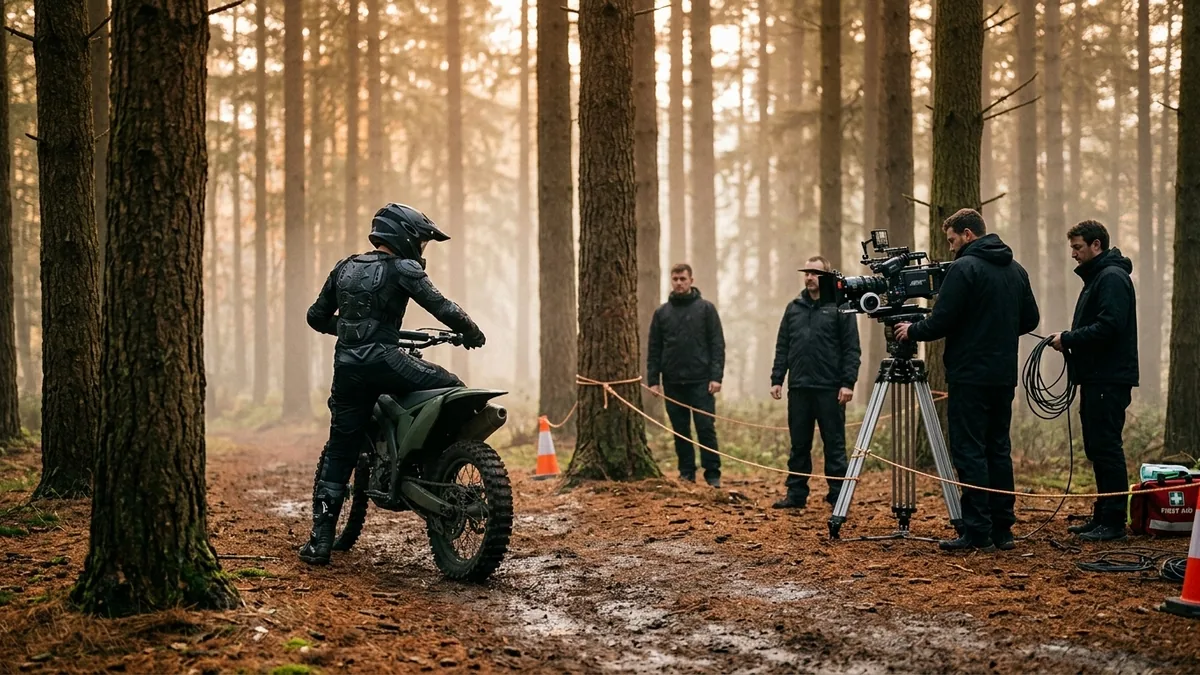
Trained stunt riders
Matched to the vehicle and the stunt.
Full protective gear
Helmets and armor, even when the shot hides them.
A marked course
Cones, barriers and a clear run-off area.
Medic standby
Recommended for jumps and high-speed riding.
Real-world examples
The dirt-bike jump
A rider jumps a ramp on a private motocross track. That is a motorcycle stunt, declared with the rider, the jump and the track.
The ATV ride-out
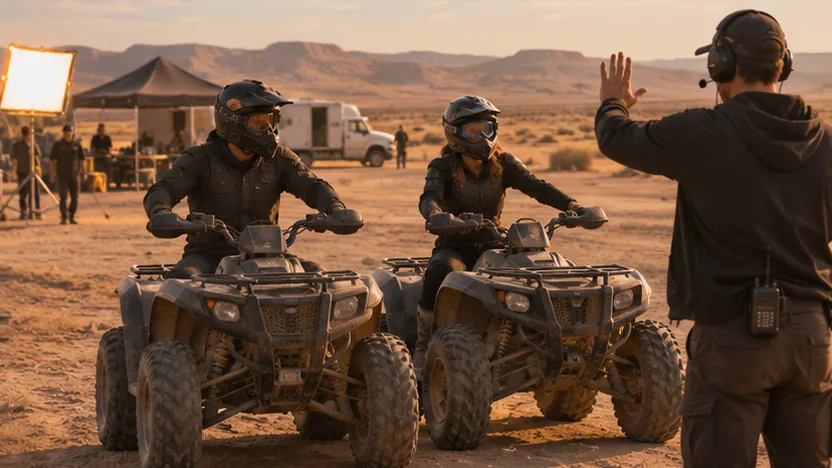
Three ATVs race across desert land toward camera. That is a recreational vehicle stunt with three vehicles, trained riders and a marked course.
The snowmobile chase
Two snowmobiles chase across a snowfield. That is a recreational vehicle stunt at a remote location, so the medic and access plan matter.
What a declaration looks like
An example of the details to send for one stunt scene (made up for illustration):
| Scene | 11: desert ride-out |
|---|---|
| Stunt | Three riders on ATVs racing toward camera, one controlled slide |
| Category | Recreational vehicles: ATV |
| Number of vehicles | 3 |
| Dates | Shoot day 2 |
| Safety | Trained riders in full gear, marked course with run-off, coordinator signals, medic on standby |
Good to know
Remote locations
Snow and desert shoots need a plan for getting help to a rider quickly.
Owned vs. rented
Rental vehicles may come with their own requirements.
Street bikes on roads
A motorcycle in a road chase also follows the driving rules.
Common mistakes
Letting an actor ride the stunt
Tell us if a principal actor rides. See When an Actor Does the Stunt.
Forgetting the number of vehicles
Each vehicle in the stunt matters to the underwriter.
Adding a jump on the day
A jump is a bigger stunt than a ride-by. Update us first.
Assuming workers’ comp covers the riders
Ask first. See Stunts & Workers' Comp.
Watch: Motorcycles & ATVs
Gaff explains how motorcycles, ATVs and other recreational vehicles are declared as stunts.
Common questions
Is riding an ATV on camera a stunt?
A simple ride-by usually is not. Jumps, slides, chases, falls or speed for effect are stunts and must be declared.
Which recreational vehicles count?
ATVs, go-carts, mopeds, motorcycles, scooters, Segways and snowmobiles are the usual list.
Do I need to say how many vehicles?
Yes. The number of vehicles in the stunt is part of the declaration.
Can these stunts share a policy with workers’ comp?
Usually not. Tell us you need both and we’ll help you set it up.
Is a Segway or scooter really a stunt?
If it is part of a stunt (a crash, a chase, speed for effect), yes.
Do riders need helmets in the shot?
Riders should wear protective gear. If the scene shows no helmet, discuss it with your coordinator and tell us.
Can an actor ride the vehicle?
Tell us first. It can affect cast coverage.
Ready to add your stunts?
Our team at MovieInsure places stunt coverage for productions of every size: short shoots, annual policies and features. Tell us what the stunt is and when you shoot, and we'll tell you what's needed.
Or call 1.888.959.0772 · quotes@movieinsure.com

More from the Stunt Library
Precision Driving, Chases & CrashesHow Stunt Insurance WorksFalls & High FallsStunts & Workers' CompBefore Stunt Day: ChecklistWhen an Actor Does the Stunt
StuntInsure.com is an educational site from MovieInsure.com, Inc., a licensed insurance agency (California License No. 0I32322). Coverage depends on the program, the policy and underwriting approval; this page explains how it usually works and is not a promise of coverage.