
-
9036 Reseda Blvd #105 Northridge, Ca 91324
-
Email Address quotes@movieinsure.com
-
Phone No 1.888.959.0772
Stunt Library · Driving
Precision Driving, Chases & Crashes
Vehicle stunts range from a controlled turn on a closed road to a full chase that ends in a collision. Each step up is underwritten differently, and vehicles bring their own coverage questions.
Key points
- Driving stunts are split into precision driving and chases, collisions and vehicle explosions.
- Where you drive matters: a public road (closed for the shoot), a race track, or off-road.
- Driving stunts touch several parts of the policy: liability, the vehicles and equipment.
- Professional stunt drivers, road closures and permits are expected.
- Driving stunts can’t share a policy with workers’ comp. See Stunts & Workers' Comp.
Precision driving vs. chases and crashesWhere you drive changes the riskWhat underwriters want to knowWhat you'll need on setReal-world examplesWhat a declaration looks likeGood to knowCommon mistakesVideoFAQ
Precision driving vs. chases and crashes
Precision driving
Controlled, choreographed driving: tight turns, near misses, skids, fast passes past the camera.
Chases
Two or more vehicles in pursuit, often with traffic, pedestrians or obstacles staged around them.
Collisions
Planned contact: a vehicle hitting another vehicle, a wall or a prop.
Vehicle explosions
Any fire or explosive effect on a vehicle. This also follows the pyro rules: Pyrotechnics, Explosions & Fire.
Where you drive changes the risk
- Public roads, closed and controlled for the shoot, with permits and road-closure crews.
- Race tracks, with lower speeds and a controlled environment.
- Off-road, on private land, desert, dirt or trail locations.
Motorcycles, ATVs and other recreational vehicles have their own page: Motorcycles & Recreational Vehicles.
What underwriters want to know
- The action. Precision driving, chase, collision or explosion, and how many vehicles.
- The location. Public road, track or off-road, and the road-closure plan and permits.
- The drivers. Professional stunt drivers and their experience, and whether any actor drives.
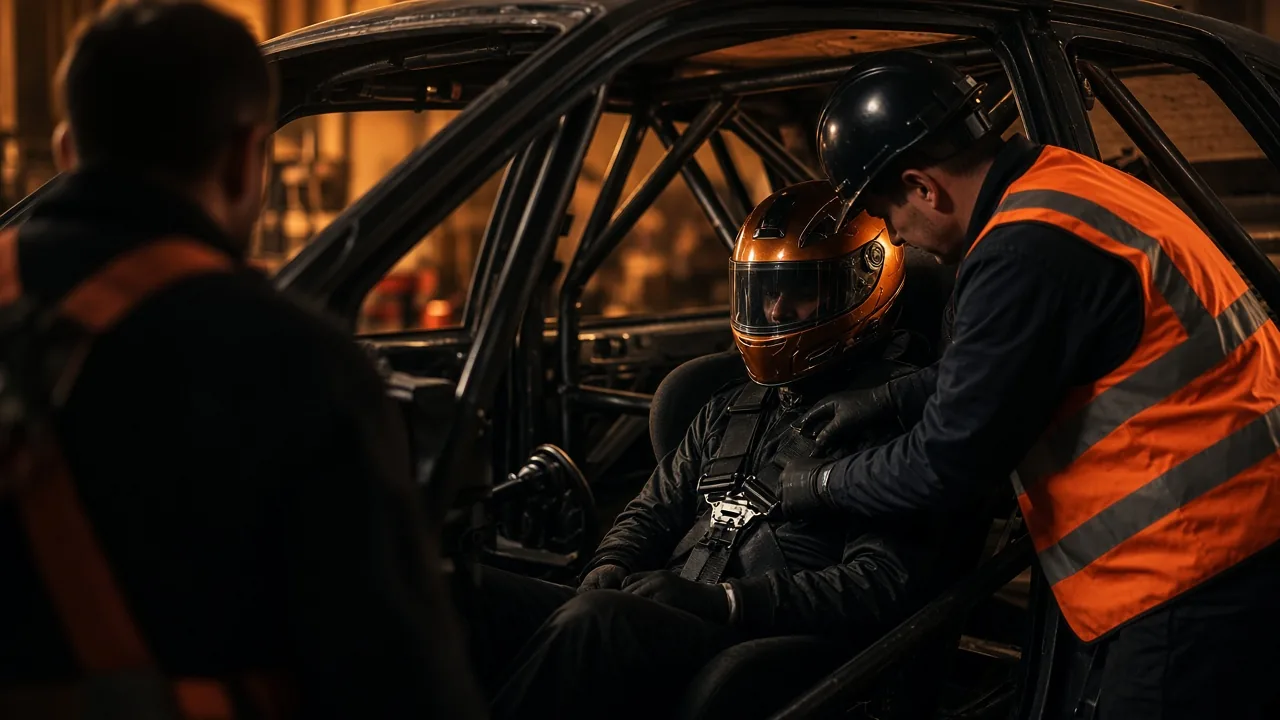
- The vehicles. Who owns them, their value, and any safety fitting (roll cage, harnesses, fuel cell).
- Speeds and distances. How fast, how close to crew, cameras and the public.
What you'll need on set
Professional stunt drivers
Never ask an untrained driver to perform a stunt.
A road-closure plan
Permits, police or traffic control, and a locked-off route.
Prepared vehicles
Safety-fitted stunt cars where needed, inspected before every take.
Fire and medic standby
Especially for collisions and anything involving fire.
Real-world examples
The hero arrival
A car slides to a stop in front of a building, on a closed street. That is precision driving on a public road, with a road-closure plan.
The two-car chase
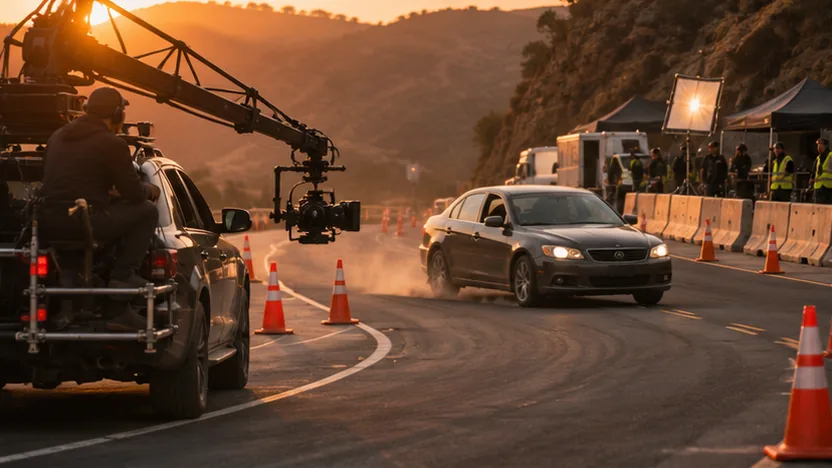
Two cars chase through a closed industrial area, with near misses and a fishtail turn. That is a chase, with professional drivers and a locked-off route.
The T-bone
A stunt car hits a prepared car at an intersection. That is a collision, and it needs safety-fitted vehicles, fire standby and a medic.
What a declaration looks like
An example of the details to send for one stunt scene (made up for illustration):
| Scene | 27: highway pursuit |
|---|---|
| Stunt | Two-car chase with a controlled spin-out on a closed road |
| Category | Chase |
| Number of vehicles | 2 stunt cars, 1 camera car |
| Dates | Shoot days 9 and 10 |
| Safety | Road closure with permit, professional stunt drivers, roll cages and harnesses, fire and medic standby |
Good to know
Camera cars count
Camera cars and tracking vehicles are part of the driving plan.
Actors in cars
If an actor drives in a stunt, tell us. Process trailers or a double are common.
Rented picture cars
Rental companies often have their own insurance requirements.
Common mistakes
Calling a chase "precision driving"
Pursuit, collisions and explosions are higher-risk categories. Declare what you are actually filming.
Forgetting the vehicles
Picture cars and stunt cars need their own coverage on the policy.
Shooting on open roads
Driving stunts need closed, controlled roads.
Putting it on the workers’ comp policy
Driving stunts can’t share a policy with workers’ comp. Tell us both and we’ll help.
Watch: Car Stunts: Precision Driving vs. Chases
Gaff explains the difference between precision driving and chases, collisions and vehicle explosions.
Common questions
Is precision driving a stunt?
Yes. Any choreographed or high-skill driving on camera is declared as a stunt scene.
Are car chases insured differently from precision driving?
Yes. Chases, collisions and vehicle explosions are a higher category than precision driving, and need more detail.
Do I need to close the road?
For driving stunts on public roads, expect to need permits and a closed, controlled road.
Are the cars covered?
Vehicles need their own coverage on the policy. Tell us which vehicles you are using and who owns them.
Can driving stunts go on the same policy as workers’ comp?
No. Tell us you need both and we’ll help you set it up.
Is a car sliding to a stop a stunt?
Yes. Choreographed driving for effect is precision driving and should be declared.
Do camera cars need to be declared?
Tell us about every vehicle in the driving plan, including camera cars.
Can we shoot driving stunts at a race track?
Yes. Race tracks are a common, controlled option and are declared as such.
Ready to add your stunts?
Our team at MovieInsure places stunt coverage for productions of every size: short shoots, annual policies and features. Tell us what the stunt is and when you shoot, and we'll tell you what's needed.
Or call 1.888.959.0772 · quotes@movieinsure.com

More from the Stunt Library
How Stunt Insurance WorksMotorcycles & Recreational VehiclesPyrotechnics, Explosions & FireStunts & Workers' CompBefore Stunt Day: ChecklistFight Scenes
StuntInsure.com is an educational site from MovieInsure.com, Inc., a licensed insurance agency (California License No. 0I32322). Coverage depends on the program, the policy and underwriting approval; this page explains how it usually works and is not a promise of coverage.